What if investing in real estate no longer required purchasing an entire property?
Real-estate tokenisation offers a potential answer by using digital tokens to represent rights associated with property, allowing investment interests to be divided into smaller units and potentially transferred through digital platforms. Beyond its technological dimension, this development raises fundamental legal questions: what does an investor actually own, how are those rights protected, and how can digital transactions be reconciled with traditional property-registration systems?
These questions are particularly relevant in Qatar, where the Ministry of Justice announced on 27 August 2026 that the Cabinet had approved a draft law regulating real-estate tokenisation and the trading of real-estate tokens, together with draft executive regulations. The proposal seeks to clarify tokenholders’ rights, regulate trading and connect tokenisation with the real-estate registration system.
The proposed framework represents a significant step towards addressing the legal challenges of digital property investment. However, its effectiveness will depend on how clearly it defines ownership rights, allocates regulatory responsibilities and protects investors. As the legislation remains a proposal unless and until its enactment and entry into force are officially confirmed, its potential impact must be assessed alongside Qatar’s existing legal framework and the experience of other jurisdictions.
However, the Cabinet’s approval of a draft does not, by itself, establish that the legislation has been enacted or entered into force. The proposed framework must therefore be analysed as draft legislation unless official promulgation and commencement are confirmed. Its eventual impact will depend on the final legal text, implementing regulations and the coordination of the competent authorities.
1. Understanding Real-Estate Tokenisation and Its Advantages
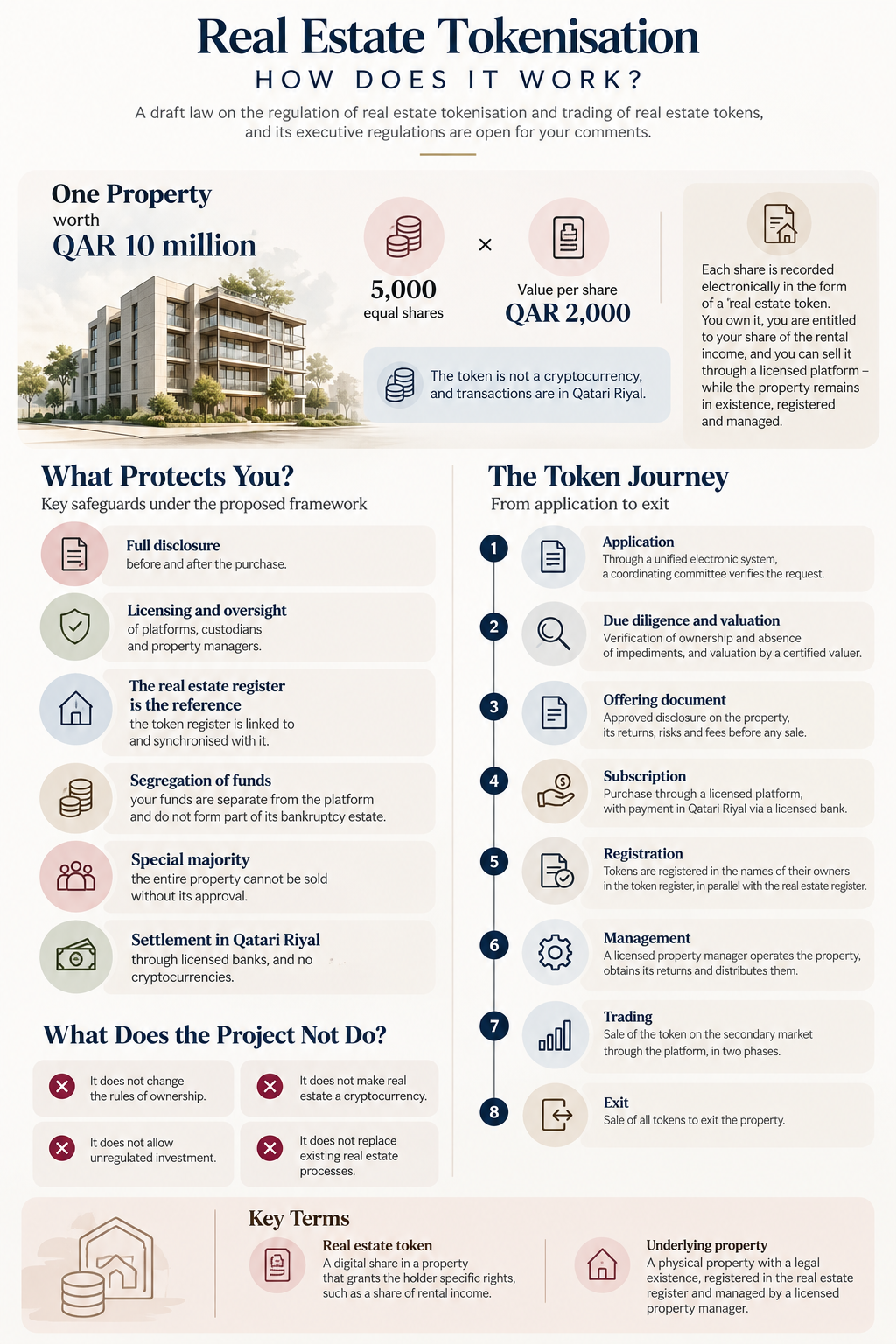
Tokenisation allows rights associated with a real-estate asset to be represented digitally and potentially divided into smaller investment interests. For example, a property valued at QAR 10 million could theoretically be represented by 5,000 interests valued at QAR 2,000 each, subject to the applicable legal structure and offering terms. This may reduce the capital required to participate in a particular investment, although it does not eliminate investment risk or guarantee that the interests can be sold easily.
One potential advantage is broader investor participation. By making smaller investment units available, tokenisation may enable investors to participate in property-related opportunities without purchasing an entire property. It could also create opportunities for portfolio diversification and the development of new investment products. For property owners, a properly structured offering may provide an additional method of raising capital, subject to applicable ownership, company and financial-services requirements.
Tokenisation may also improve the administration and traceability of transactions. Digital records can facilitate the recording of transfers, while regulated platforms may provide standardised information about the property, the investment structure and associated costs.
Nevertheless, technology alone cannot verify legal title, identify undisclosed encumbrances or guarantee the accuracy of valuations. Effective due diligence and legally enforceable registration remain essential.
A further potential advantage is the development of a more innovative and attractive investment environment. Qatar’s proposed framework seeks to regulate a new category of property-related activity while establishing safeguards for investors. If implemented effectively, it could support market development and encourage participation by local and foreign investors. These outcomes, however, remain objectives rather than guaranteed consequences of tokenisation.
2. Disadvantages and Legal Risks
The first and most important challenge concerns the legal nature of the token. A token may be described commercially as representing a property interest while legally conferring only shares in a company or a contractual entitlement to income. This distinction determines the rights available to investors, the parties against whom those rights may be enforced and the remedies available in the event of a dispute. The proposed framework should therefore define each token model precisely and require disclosure of the rights actually granted.
This issue is particularly significant under Qatar’s Law No. 5 of 2024 Regulating Real Estate Registration. Article 4 addresses registration requirements for transactions affecting ownership and other original real rights in immovable property, while Article 37 addresses information recorded in the real-estate register. The proposed tokenisation regime must clarify how digital records interact with this statutory registration system. Without clear rules, uncertainty could arise over whether a token transfer also transfers a legally recognised proprietary interest in the underlying property.
Liquidity is another concern. Although tokenisation may facilitate transfers, it cannot guarantee that buyers will be available when investors wish to sell. Secondary-market trading may be limited by demand, eligibility requirements, transfer restrictions or platform rules. Furthermore, a token’s trading price may differ from the underlying property’s valuation, particularly where the property is not independently valued regularly. Investors should therefore be informed that tokenisation does not guarantee capital appreciation, a particular return or an immediate exit.
Technology and operational risks must also be addressed. Digital platforms may experience cybersecurity incidents, software failures, unauthorised transfers or interruptions to service. Investors may face additional difficulties if a custodian or platform becomes insolvent or loses access to the relevant records. The legal framework should clarify custody arrangements, segregation of client assets, recordkeeping obligations and procedures for transferring or recovering assets following operational failure.
Finally, governance and regulatory overlap may create practical difficulties. Where tokens represent interests in a property-owning company, investors’ rights may depend on the company’s constitutional documents, shareholder arrangements and management decisions. Disputes may concern income distributions, property maintenance, voting rights or the eventual sale of the asset. Clear rules on governance, disclosure, conflicts of interest and the responsibilities of regulatory authorities are therefore necessary to protect investors and support market confidence.
3. International Comparisons
The Qatar Financial Centre provides a relevant domestic comparison through its Digital Asset Regulations 2024. This framework regulates specified digital-asset activities within the QFC, including token-related services. However, it should not be confused with the proposed nationwide real-estate tokenisation regime, as the two frameworks have distinct legal scopes.
The QFC model nevertheless offers useful considerations regarding token ownership, transfers, custody and the regulation of service providers. The European Union has adopted Regulation (EU) 2022/858, which establishes a pilot regime for certain market infrastructures using distributed-ledger technology in relation to financial instruments. Its relevance lies in the use of a controlled regulatory framework to test innovative market infrastructure while maintaining regulatory safeguards. It is not, however, a comprehensive regime for every form of real-estate tokenisation. Qatar should therefore draw lessons from its regulatory design without assuming that the EU rules apply directly to property tokens under Qatari law.
Dubai provides a regional operational example. The Dubai Land Department launched a real- estate-tokenisation pilot and subsequently announced a second phase enabling secondary-market resale from 20 February 2026. This phased approach illustrates how tokenisation projects can be developed progressively, with attention to market readiness, regulatory coordination and investor protection. It may provide useful practical lessons for Qatar, particularly regarding the transition from initial offerings to secondary trading.
These comparisons demonstrate that no single model should be adopted without adaptation. Qatar’s approach must reflect its existing property-registration legislation, institutional responsibilities and financial-services framework. The objective should be to establish a coherent domestic system that provides legal certainty while permitting appropriately supervised Innovation.
4. Recommendations for Improving the Proposed Law
First, the legislation should expressly distinguish between tokens representing direct proprietary rights, shares in property-owning entities and contractual rights to income. It should clarify the legal consequences of issuing and transferring each category of token, including whether additional registration formalities are required. The relationship between the token register and the official real-estate register should also be clearly defined, including how inconsistencies between the two records are resolved.
Second, investor protection should be supported by comprehensive disclosure requirements. Before investing, individuals should receive information about the property, ownership structure, existing mortgages and encumbrances, valuation methodology, fees, risks and restrictions on transfers. The disclosure should explain the precise rights attached to the token and whether investors possess direct ownership rights or merely contractual or corporate rights. Material developments affecting the property or the investment should also be disclosed throughout the investment period.
Third, the framework should establish effective safeguards for client assets and digital records. These should address custody arrangements, segregation of client funds, cybersecurity, internal controls, recordkeeping and the consequences of platform or custodian insolvency. Investors should have clear procedures for establishing ownership, transferring their interests or seeking recovery where a service provider fails. These protections are particularly important because technology-based records do not, by themselves, resolve questions of legal ownership or insolvency priority.
Fourth, the law should clearly allocate responsibilities among the competent authorities. The proposed roles of the Ministry of Justice, the Qatar Financial Markets Authority, the Qatar Central Bank and the General Authority for Regulating the Real Estate Sector should be reflected in a coherent supervisory structure. Licensing requirements, reporting obligations, enforcement powers and complaint-handling procedures should be sufficiently clear to prevent regulatory overlap and uncertainty for market participants.
Finally, Qatar could consider phased implementation, supported by regulatory guidance and periodic review. A controlled approach would allow the authorities to assess operational risks, investor understanding and secondary-market performance before expanding the framework.
Any such approach should remain subject to clear eligibility criteria, enforceable investor rights and appropriate supervision. Flexibility should facilitate innovation without weakening the legal certainty that property transactions require.
In Conclusion, Qatar’s proposed real-estate-tokenisation framework presents an opportunity to modernise property-related investment and introduce new financial products. Its potential benefits include broader investment participation, improved transaction administration and the development of a more innovative market. These advantages will depend on the quality of the legal framework, the reliability of the underlying records and the availability of effective investor protections.
The principal challenge is ensuring that digital tokens correspond to clearly defined and enforceable rights. The legislation should reconcile tokenisation with Qatar’s real estate registration system, establish appropriate safeguards for client assets, regulate intermediaries and clarify the remedies available to investors. International experience from the QFC, the European Union and Dubai offers useful guidance, but the final framework must remain consistent with Qatar’s own legal system.
Ultimately, the success of real-estate tokenisation will depend not simply on the adoption of new technology, but on whether the law provides investors, property owners and service providers with a clear understanding of their rights and obligations. Tokenisation should facilitate investment and transactions without creating uncertainty about the legal ownership and enforceability of property rights.
As Qatar explores the potential of real-estate tokenisation, the central question is not simply whether property rights can be represented digitally, but how such rights can be recognised, protected and enforced within the existing legal system. Addressing this question will be essential to developing a framework that encourages innovation while preserving legal certainty and investor confidence.